Why it fits:
Trade-off:
C$
Photo credit: Illustration generated using AI for editorial purposes.
TechNextPicks Editorial
Fear is understandable, but the AI and job future is not defined by mass job loss. The real story is how people adapt, gain new skills, and use AI productivity tools to deliver better work.
Updated January 2026 · By AHMAD · Focus keyword: AI and job future
Photo credit: Generated using AI.
Fear is a natural response when work and technology intersect. Jobs are tied to income, dignity, and identity, so any tool that appears capable of replacing human effort naturally causes concern. This pattern has repeated throughout history. When factories introduced industrial machinery, people feared mass unemployment. When computers entered offices, many believed clerical work would disappear. When the internet arrived, traditional businesses worried about survival. In each case, work changed--but society adapted.
Artificial intelligence fits into this same historical cycle. It is not an extinction event for human labor, but a shift in how work is done. The difference today is speed: AI evolves faster than previous technologies, which makes the transition feel more intense. That intensity often fuels fear rather than thoughtful adaptation.
A practical example can be seen in customer service. AI chatbots now handle basic questions like order status, password resets, or appointment scheduling. This has reduced the need for large teams answering repetitive queries. However, human agents have not disappeared. Instead, their roles have shifted toward handling complex issues, emotional situations, and decision-making that requires empathy and judgment. The work became more meaningful, not less.
Another example comes from healthcare. AI systems assist doctors by analyzing medical images, flagging potential risks, or reviewing patient data faster than any human could. These systems do not replace doctors; they reduce diagnostic errors and free up time for patient care. A physician's role becomes more focused on interpretation, treatment planning, and human connection--areas where AI cannot replace lived experience and ethical responsibility.
In manufacturing and logistics, AI and automation have improved workplace safety. Machines now perform tasks that are physically dangerous or repetitive, such as heavy lifting or precision assembly in hazardous environments. Human workers increasingly supervise, manage, and maintain these systems rather than performing the most risky tasks themselves. This shift reduces injury rates and extends career longevity.
Even in creative and knowledge-based work, AI is acting as an assistant rather than a substitute. Writers use AI to organize ideas or summarize research, designers use it to generate drafts, and analysts use it to explore data patterns faster. The final decisions, creative direction, and accountability remain human. Productivity increases not because humans work less, but because they work smarter.
Perspective matters because AI is not making choices on its own--it reflects how people design and deploy it. If organizations use AI solely to cut costs without investing in people, fear becomes justified. But when AI is used to remove friction, reduce risk, and support better outcomes, it becomes a productivity multiplier rather than a threat.
Adapting to AI does not mean competing with machines. It means learning where human strengths remain irreplaceable: critical thinking, ethics, leadership, creativity, and emotional intelligence. Workers who understand their domain and know how to use AI as a tool are more resilient than those who resist change entirely.
The real lesson from history is not that technology eliminates work, but that it reshapes roles. Some tasks disappear, new ones emerge, and many evolve. Fear focuses attention on what is lost; perspective helps people see what can be built. With thoughtful adoption, education, and ethical oversight, AI can lead to safer workplaces, higher productivity, and roles that better align with human strengths.
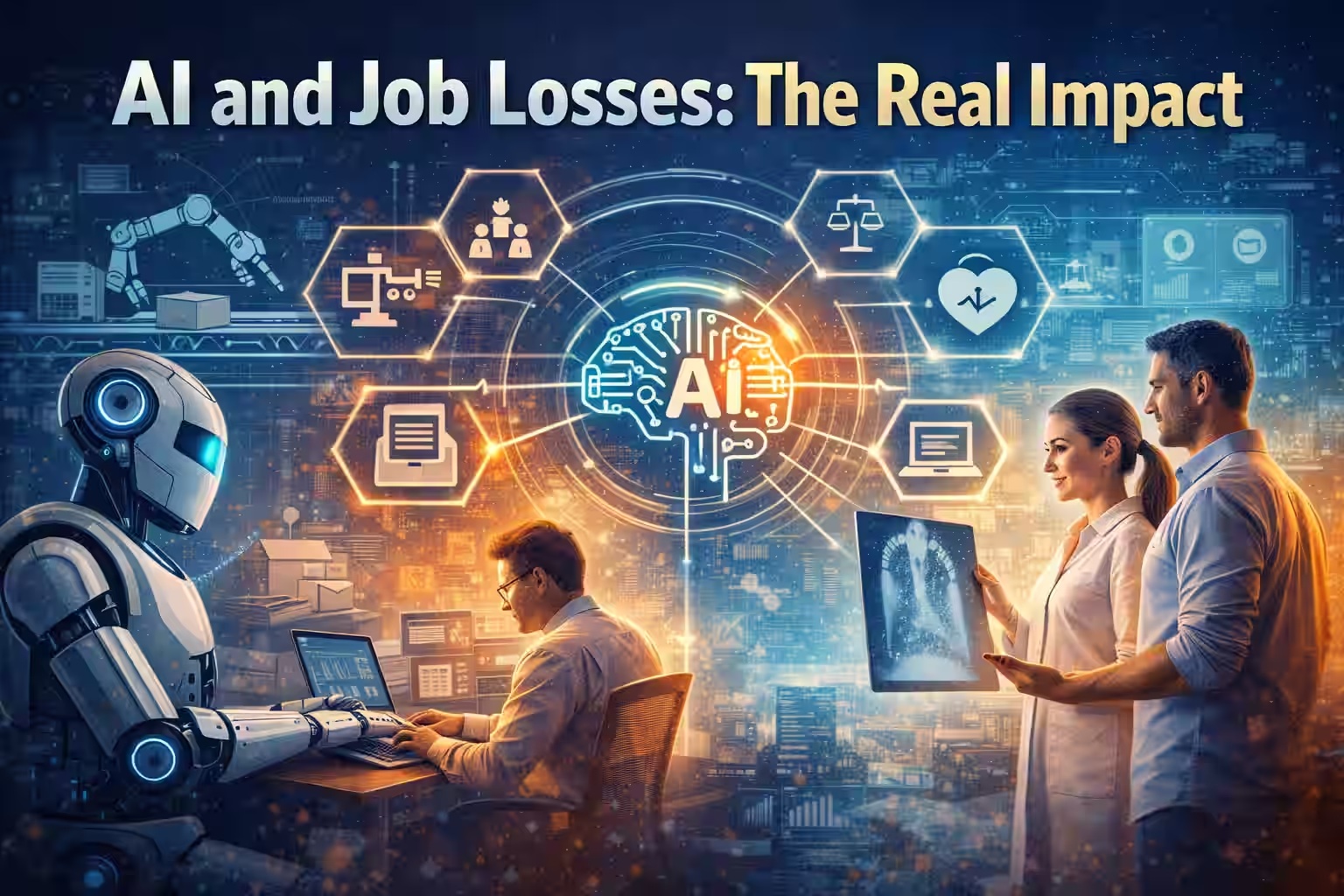
Photo credit: Generated using AI.
When people hear about AI and job losses, the concern often assumes that entire professions will disappear. In reality, AI rarely replaces a job as a whole. Instead, it targets specific tasks within a role, especially those that are repetitive, predictable, and rules-based. This distinction is important because most jobs are made up of many different tasks, not just one.
For example, in accounting and finance, AI systems can automatically process invoices, categorize transactions, and flag anomalies far faster than humans. These tasks used to consume a large portion of an accountant's time. However, accountants themselves are still needed to interpret financial data, ensure regulatory compliance, advise clients, and make judgment calls -- responsibilities that require experience and contextual understanding.
In office administration, AI tools can schedule meetings, sort emails, and generate reports. While this reduces the need for manual coordination, it increases the value of professionals who can manage workflows, communicate across teams, and handle exceptions that software cannot anticipate. The role evolves rather than disappears.
In software development, AI can now generate boilerplate code, detect bugs, and suggest improvements. This does not eliminate developers; it shifts their focus. Engineers spend less time writing repetitive code and more time designing systems, reviewing logic, ensuring security, and aligning software with real-world needs. Judgment and domain expertise become more critical, not less.
Jobs that rely heavily on human interaction and empathy, such as healthcare, education, counseling, and leadership roles, tend to become more valuable as AI adoption increases. In healthcare, AI assists with diagnostics and data analysis, but doctors, nurses, and caregivers remain responsible for treatment decisions, ethical considerations, and patient relationships. In education, AI can personalize learning materials, but teachers guide, motivate, and support students in ways algorithms cannot.
Even in industries like customer support, where automation is common, the pattern remains consistent. AI handles routine questions quickly, while human agents focus on complex issues, emotionally sensitive cases, and problem resolution that requires discretion. This leads to fewer repetitive tasks and a greater emphasis on communication skills and decision-making.
The real impact of AI, then, is not widespread job elimination, but job restructuring. Tasks that are easy to automate fade into the background, while skills related to judgment, creativity, ethics, and domain knowledge rise in importance. Workers who adapt by learning how to work alongside AI often become more productive and more valuable to their organizations.
Understanding this shift helps replace fear with clarity. AI does change work -- but it changes what people do, not whether people are needed. The future belongs to roles that combine human insight with intelligent tools, rather than trying to compete with them.
See a deeper breakdown in AI in the workplace.
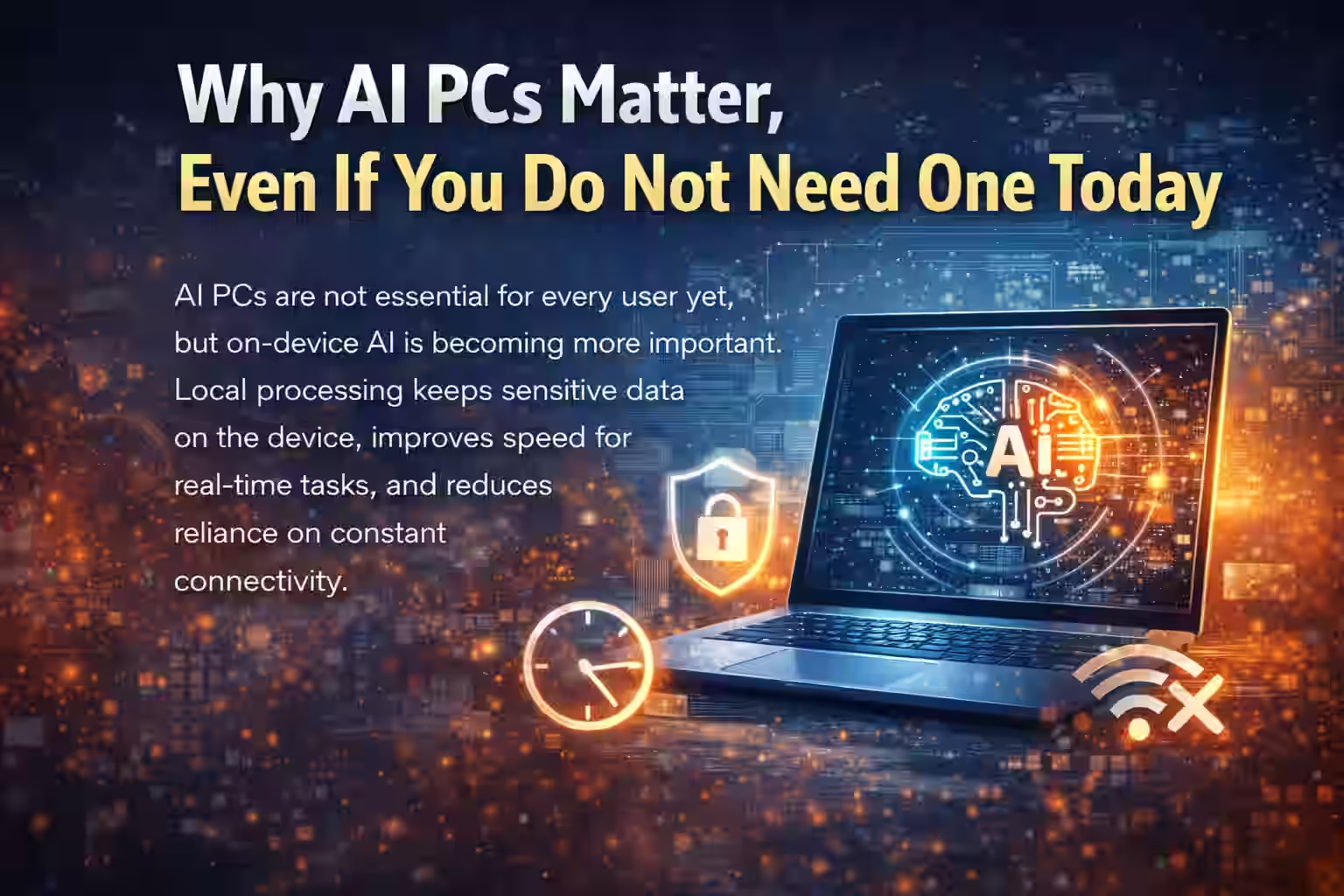
Photo credit: Generated using AI.
AI PCs are often misunderstood as devices that everyone must upgrade to immediately. In reality, most people can continue using their current computers without any major limitations. Today, there is no single must-have feature that makes AI PCs essential for everyday users. However, their importance lies not in immediate necessity, but in how computing is gradually changing.
The most significant shift is the move toward on-device AI, where tasks are processed locally rather than sent to the cloud. This approach keeps sensitive data -- such as personal files, medical information, or business documents -- on the device itself. By reducing the need to transmit data over the internet, on-device AI improves privacy and lowers exposure to security risks.
Speed is another major advantage. Real-time tasks like voice recognition, image processing, language translation, and system optimization work faster when they run locally. Cloud-based AI depends on internet latency and server availability, which can introduce delays. AI PCs eliminate much of that friction, allowing responses to happen instantly, even when connectivity is poor or unavailable.
Reliability also improves when AI workloads run on the device. Users are no longer dependent on a constant internet connection to access intelligent features. This matters in travel scenarios, remote work environments, and regions with unstable networks. AI PCs can continue functioning intelligently even when offline, which changes how people interact with technology on a daily basis.
From an organizational perspective, AI PCs represent future readiness rather than urgency. Companies may not need them across all roles today, but specific functions -- such as security, design, data analysis, and compliance -- benefit earlier. As AI becomes embedded in more software, having hardware designed to support these workloads locally becomes a strategic advantage rather than a luxury.
Another important factor is energy efficiency. AI PCs are built with specialized processors designed to handle AI tasks more efficiently than traditional CPUs or GPUs. This reduces power consumption for everyday AI features, extending battery life and lowering operational costs over time.
The slow adoption of AI PCs so far reflects a realistic transition, not a failure. Technology rarely shifts overnight. Just as SSDs, multi-core CPUs, and integrated graphics took years to become standard, AI hardware is following a similar path. Early models prepare the ecosystem -- developers, operating systems, and applications -- for broader use in the future.
In practical terms, AI PCs matter because they change where intelligence lives. Instead of being locked behind servers and subscriptions, AI becomes a built-in capability of personal devices. While most users do not need this power today, the software and workflows of tomorrow are being designed with this model in mind.
Understanding AI PCs as a long-term foundation rather than an immediate requirement helps avoid unnecessary pressure to upgrade. They are not about replacing current devices, but about aligning hardware with the future direction of computing -- one where intelligence is local, fast, private, and always available.
Learn the basics in AI-powered PCs explained.
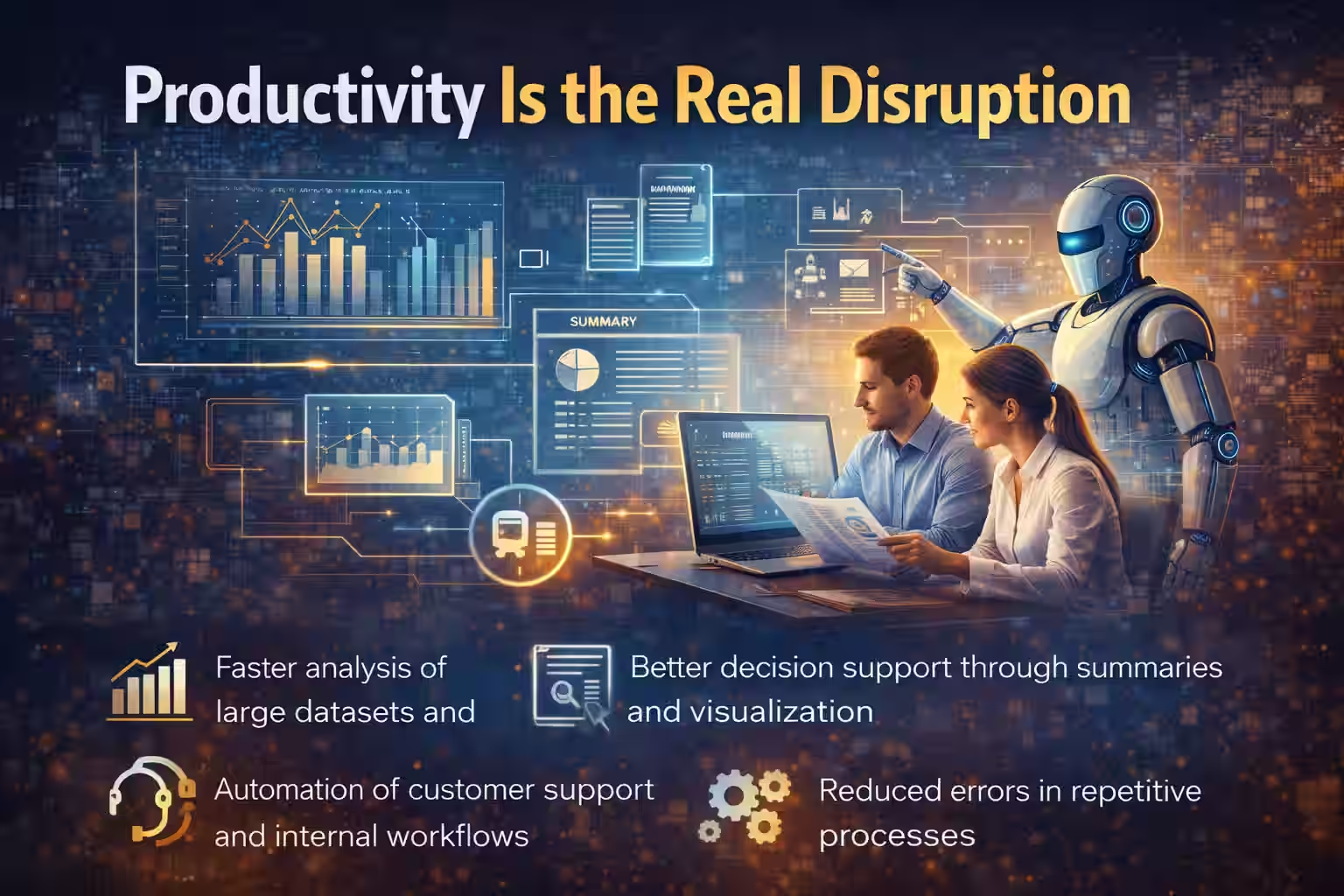
Photo credit: Generated using AI.
When people talk about AI disrupting jobs, they often overlook what is actually changing day-to-day work. The biggest disruption is not job removal -- it is how much faster and more accurately work can be done. AI changes productivity at a foundational level, affecting how decisions are made, how time is spent, and how errors are reduced across organizations.
One of the most visible impacts is faster analysis of large datasets and reports. Tasks that once took days -- reviewing spreadsheets, reading long documents, comparing trends -- can now be completed in minutes with AI-assisted analysis. This does not eliminate analysts or managers; it allows them to focus on interpreting results, asking better questions, and making informed decisions instead of spending time gathering information.
AI also improves decision support through summaries and visualizations. Instead of reading dozens of reports, leaders can see key insights presented clearly, supported by charts and explanations. This reduces cognitive overload and helps teams move from data to action more quickly. Decisions become more consistent because they are based on broader information rather than intuition alone.
Another major productivity shift comes from automation of customer support and internal workflows. AI systems handle routine inquiries, ticket routing, document classification, and process tracking. This does not remove human involvement -- it allows employees to concentrate on complex cases, strategic planning, and human interaction where judgment and empathy are required.
AI also plays a critical role in reducing errors in repetitive processes. Manual data entry, compliance checks, scheduling, and reporting are all areas where small mistakes can accumulate into serious problems. AI systems excel at consistency, catching anomalies and preventing errors before they escalate. This improves quality, reliability, and trust across operations.
The real disruption, then, is not fewer people working -- but people working differently. Productivity gains come from removing friction, not removing humans. AI shifts work away from routine execution toward oversight, creativity, and decision-making. Organizations that understand this see AI as a productivity multiplier rather than a replacement engine.
In this context, productivity becomes the competitive advantage. Teams that adopt AI thoughtfully can deliver better results with less strain, improve work-life balance, and build systems that scale more sustainably. That is the true transformation taking place -- not job loss, but a redefinition of how value is created.
Recommended tools are outlined in AI productivity tools. For on-device privacy and future-ready hardware context, see what is an AI PC .
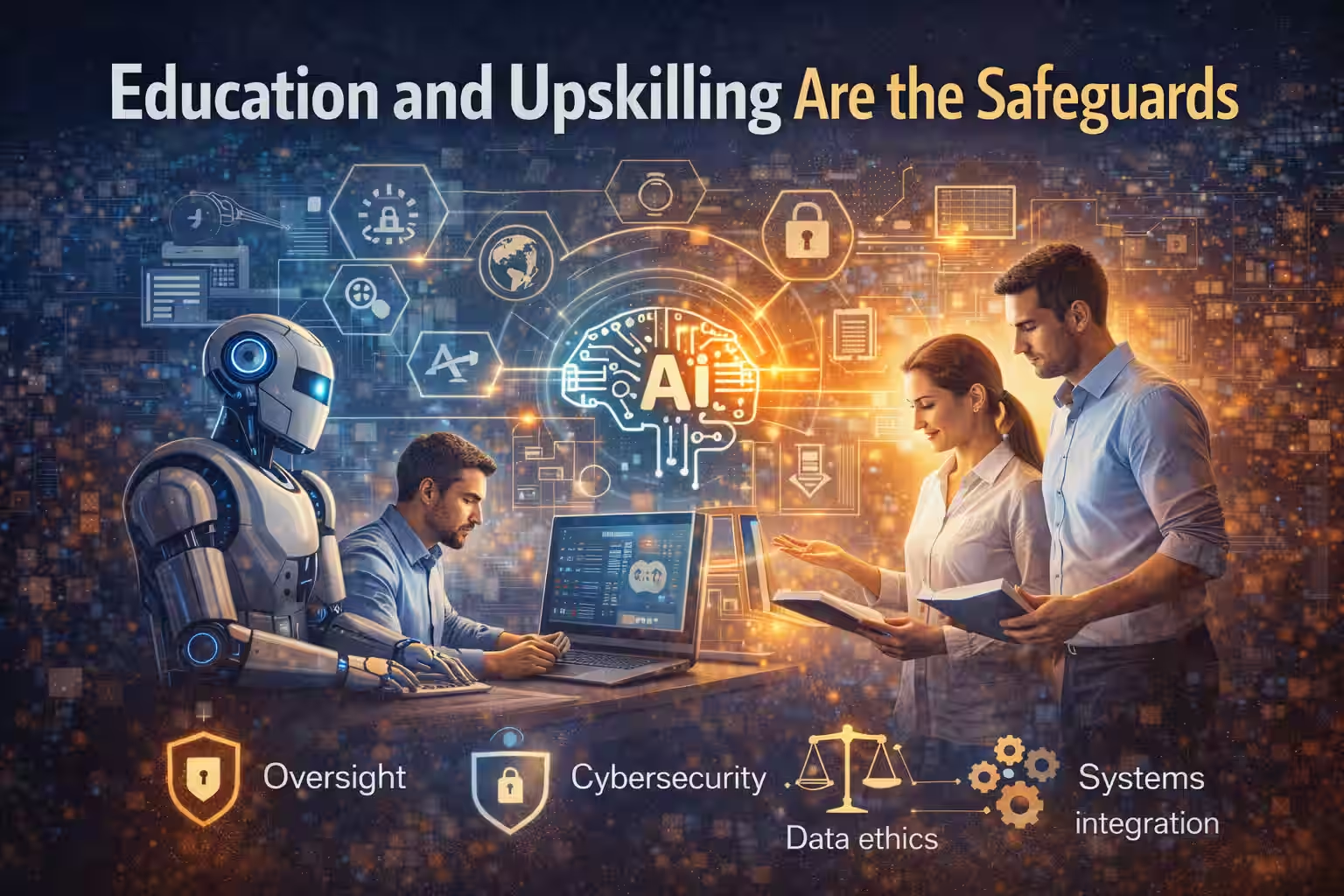
Photo credit: Generated using AI.
As AI becomes more embedded in everyday work, the strongest protection against disruption is not avoiding technology -- it is learning how to guide, evaluate, and apply it responsibly. The future of work will increasingly reward people who understand how AI systems function, where they are useful, and where human judgment must remain in control.
AI systems do not operate independently of human decisions. They are designed, configured, and deployed by people. This is why roles related to oversight and governance are growing in importance. Organizations need professionals who can monitor AI outputs, question automated decisions, and ensure systems behave as intended. These roles require critical thinking and domain knowledge rather than coding alone.
Cybersecurity is another area seeing strong growth. As AI becomes part of core business systems, the attack surface expands. Protecting AI-enabled infrastructure, preventing data leaks, and securing on-device intelligence require skilled professionals who understand both security principles and how AI models interact with data. Automation increases efficiency, but it also raises the stakes for proper defense.
The rise of AI has also brought data ethics and privacy into sharper focus. AI systems rely on large datasets, which means decisions about consent, bias, transparency, and accountability matter more than ever. Professionals who can evaluate ethical risks, design fair systems, and ensure compliance with evolving regulations are becoming essential across industries.
Another fast-growing area is systems integration. AI does not work in isolation -- it must be integrated into existing workflows, software platforms, and business processes. People who can connect AI tools with real operational needs, ensure smooth adoption, and train teams to use them effectively play a key role in successful transformation.
Importantly, upskilling does not mean everyone must become a machine learning engineer. Many valuable skills are accessible to non-technical professionals: learning how to interpret AI-generated insights, validate results, manage exceptions, and apply AI outputs within real-world constraints. These skills sit at the intersection of human expertise and intelligent tools.
Education acts as a safeguard because it shifts power from the technology itself to the people who use it. Workers who continuously learn remain adaptable as roles evolve. Organizations that invest in training build resilience rather than fear. Society benefits when AI adoption is paired with human understanding and responsibility.
In the long term, the AI job future will favor those who work with intelligence, not against it -- people who see AI as a system to be guided, not an authority to be followed blindly. Upskilling turns uncertainty into agency, and that is the most reliable protection in a changing world.
Start here: AI skills for the future.
Adapting to AI does not require dramatic career changes or deep technical expertise. The most effective approach is incremental adoption -- using AI thoughtfully in areas where it saves time, reduces friction, and improves quality while keeping human intent firmly in control.
AI works best when treated as a support tool rather than an authority. Begin with low-risk tasks such as writing drafts, summarizing documents, organizing research notes, or cleaning up raw data. In these cases, AI functions like a calculator for the mind, accelerating mental work without deciding outcomes.
The key is review and intent. Humans define the goal, provide context, and validate results. AI assists with speed and structure, but judgment remains human. This mindset prevents overreliance and ensures accountability stays where it belongs.
While AI excels at pattern recognition and repetition, it struggles with judgment in ambiguous situations. Skills such as critical thinking, creativity, emotional intelligence, and ethical reasoning grow more valuable as automation increases.
Developing these skills means practicing how to question outputs, evaluate trade-offs, communicate clearly, and make decisions when there is no perfect answer. These capabilities allow people to supervise AI systems effectively rather than compete with them.
You do not need a new job title to benefit from AI. Start by identifying repetitive or time-consuming tasks in your existing role -- data entry, report formatting, customer responses, scheduling, or document comparison.
Introduce AI in small workflows and measure the impact. Even minor improvements, such as saving 10--15 minutes per task, compound over time. These small gains increase productivity, reduce fatigue, and free mental space for higher-value work.
The AI landscape moves quickly, but staying informed does not mean following every announcement or product launch. Focus on a few reliable sources and prioritize real-world use cases over speculation.
Pay attention to how AI is being applied in your industry, how regulations are evolving, and where measurable benefits are emerging. Selective learning reduces noise and helps you make informed, practical decisions rather than reactive ones.
Adapting to AI is less about chasing trends and more about building a working relationship with intelligent tools. Those who succeed will not be the ones who adopt everything first, but those who adopt thoughtfully, learn continuously, and remain in control of how AI shapes their work.
AI introduces real and serious challenges. Concerns around data privacy, misuse, bias, and regulation are valid and deserve careful attention. Like any powerful technology, AI can cause harm if it is deployed carelessly or controlled by too few stakeholders. Ignoring these risks would be irresponsible.
However, avoiding AI altogether does not eliminate those risks. In many cases, it amplifies them. When individuals, organizations, or entire sectors opt out of AI adoption, decision-making power tends to concentrate in the hands of a smaller number of actors -- large corporations, governments, or well-resourced institutions. This imbalance reduces transparency and limits public influence over how AI is designed and used.
Responsible governance depends on active participation, not disengagement. When more people understand AI systems -- how they work, where they fail, and what they affect -- there is greater pressure for ethical standards, accountability, and fair regulation. Broad adoption encourages scrutiny, competition, and better safeguards, rather than secrecy and unchecked control.
Privacy is a strong example. On-device AI and edge computing can reduce reliance on centralized data collection, keeping sensitive information closer to users. But these benefits only materialize if people engage with the technology and demand privacy-first designs. Avoidance leaves those decisions to others.
Regulation also benefits from participation. Laws and policies are more effective when policymakers, technologists, businesses, and users share practical understanding. Fear-driven rejection often leads to reactionary rules that lag behind reality. Informed engagement supports balanced regulation that protects individuals without stifling innovation.
The goal is not blind acceptance of AI, nor total resistance. The goal is responsible adoption -- using AI with clear boundaries, human oversight, and ethical intent. Progress guided by informed participation creates better outcomes than progress driven by fear or controlled by a select few.
In the long run, society benefits most when people help shape the tools that shape them. AI will continue to evolve whether individuals engage or not. Choosing participation means having a voice in how that future is built.
For policy context, read AI ethics and regulation.
AI will keep reshaping work. The people who learn how to use AI responsibly will gain more productivity and more control over their careers. The goal is not to compete with AI, but to work alongside it with clarity and confidence.
AI usually automates tasks, not entire jobs. Repetitive and rule-based work is most affected, while human-led roles continue to evolve. History shows that new technology changes job roles and creates new ones rather than eliminating work entirely. People who adapt and learn to work alongside AI stay competitive.
The most valuable skills are critical thinking, problem-solving, domain expertise, creativity, and ethical judgment. AI can generate outputs, but humans decide what to ask, what to trust, and how to apply results responsibly. Communication and decision-making skills become even more important.
For most users, no. Cloud-based AI tools already handle everyday needs. AI PCs become useful for privacy-sensitive work, offline processing, faster local models, and future workflows, but they are not essential yet for students or general professionals.
Start small and practical: writing and email assistance, research summaries, data cleanup and organization, and automating repetitive tasks. These tools save time and reduce errors without replacing your role.
No. Every profession benefits from understanding AI basics. Marketing, education, healthcare, business, and creative roles all use AI to improve speed, accuracy, and decision-making. You do not need to code, just know how to use AI tools effectively.
Structured answers: summary, actions, tools, citations.
Suggested prompts
Learner mode follow-ups